Micronebulisation disinfection

Infection prevention & micronebulisation disinfection.

HyperDryMist® is a micronebulisation disinfection process designed for demanding environments. It uses a Swissmedic-certified device, and intervention follow-up is managed in the My Synapse app.

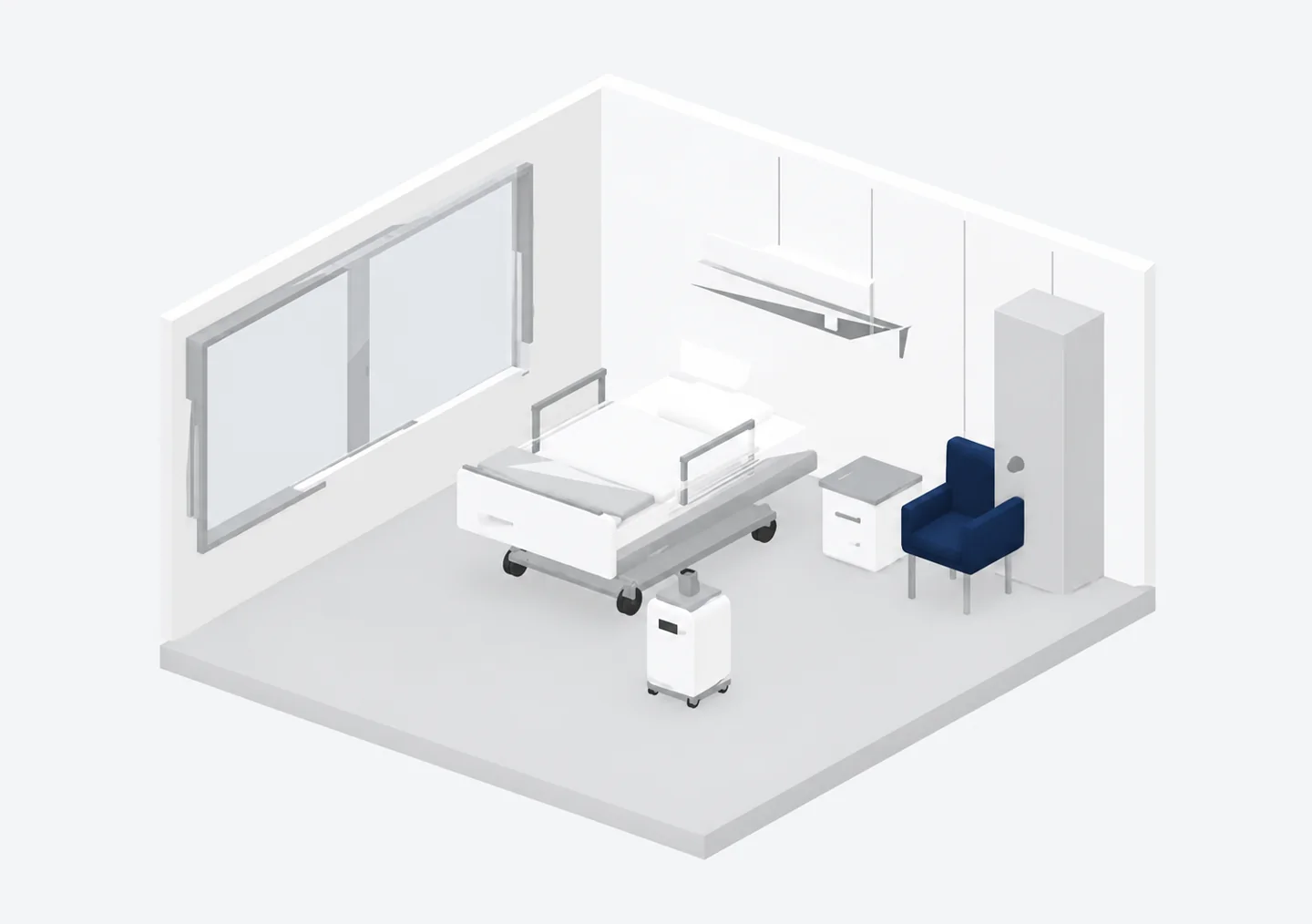
The device in a room.

01HyperDryMist®

A dry mist that reaches exposed surfaces.

The micronebuliser disperses a hydrogen peroxide disinfectant formulation. The mist circulates through the room and reaches exposed surfaces. Its fine particles help it reach complex geometries and spread around equipment.

< 1 μm

Size of 95% of the particles dispersed by HyperDryMist®.

6.6%

H₂O₂ in the 99S formulation, combined with co-formulants. The formulation is selected for the application.

02Microbiological activity

One activity spectrum, tested under different conditions.

The activity spectrum covers bacteria, viruses, fungi and spores. Each activity is linked to its microbial targets, concentration and contact time under the relevant test conditions.

BactericidalVirucidalFungicidalSporicidal

What does a 2 to 6 log reduction mean?

Each log represents a tenfold reduction in the measured quantity. Three levels are shown below:

2 log
99%
4 log
99.99%
6 log
99.9999%

How to read these figures: a measured reduction is specific to the target microorganism, surface and test protocol conditions.

What published studies report.

Findings on surfaces and equipment, to be interpreted in context.

Lodi · 2015

After manual disinfection

A poster describes a before-and-after study in 20 rooms. MDROs remained detectable in 14 rooms after manual chlorine disinfection; none were detected in samples taken after HyperDryMist®. These findings apply to the surfaces sampled under the conditions of that study.
Ferrari et al. — 2015

Zurich · 2020

An example of a published cycle

A study of 160 objects describes a cycle in a 60 m³ room: 10 minutes of dispersion, 45 minutes of exposure and 15 minutes of ventilation. This example illustrates the phases; the duration of an intervention is set according to the room and selected protocol.

Amodio et al. — 2020

Three distinct processes.

Each process has a specific purpose: surface cleaning, disinfection or sterilisation.

Cleaning

Remove soil and other material from surfaces.

Disinfection

Act on microorganisms within a defined scope and under specified conditions. This is the process described here.

Sterilisation

Eliminate all viable microorganisms through a validated process, particularly when reprocessing relevant instruments.

Illustration of the three processes.

03The five steps of the process

Micronebulisation in five steps.

A five-step intervention, from needs assessment to the cycle report.

HYPERDRYMIST® CYCLE01 / 05
View of an unoccupied room and a generic device

Define the intervention

Animation · cutaway view with a generic device.
01

Define the intervention

Synapse Swiss defines the intervention according to the premises and microbiological objective. A dedicated contact coordinates the work with your facility.

A service shaped around your facility.
02

Disperse by micronebulisation

The device disperses a hydrogen peroxide formulation. The cycle is set according to the room and applicable protocol.

Automated dispersion reaches exposed surfaces.
03

Allow for contact time

Contact time allows the formulation to act on the target microorganisms. Its duration is defined by the protocol, room volume and cycle conditions.

Contact time is defined for each cycle.
04

Monitor the ventilation phase

Ventilation helps reduce hydrogen peroxide levels in the room. It is included in the cycle and the schedule for returning the space to use.

A phase built into the intervention schedule.
05

Check and return the area to use

Planned checks inform the decision to return the area to use. Cycle follow-up and agreed checks are recorded in My Synapse.

A history that can be reviewed for quality follow-up.

The device

A Swissmedic-certified device.

The process uses a Swissmedic-certified device together with the disinfectant product.

The device and product are used according to their instructions. The cycle and checks are adapted to the premises and microbiological objective.

04Conditions of use

Formulation, materials and room release.

Hydrogen peroxide breaks down into water and oxygen. Other components depend on the formulation; 99S includes silver cations. Product choice and finishing instructions take account of surfaces and their use.

2 H₂O₂2 H₂O + O₂

Equipment compatibility

The process is designed for environments with sensitive surfaces and equipment. Compatibility is assessed according to the materials and formulation used.

Duration and room release

Dispersion, contact time and ventilation make up the cycle. Synapse Swiss coordinates the process and end-of-intervention checks with your facility.

05Intervention follow-up

Interventions followed up in My Synapse.

HyperDryMist® interventions and agreed checks are tracked in the My Synapse app. Information for quality follow-up is brought together according to the modules enabled for your facility.

Explore the My Synapse app

06Comparing processes

Six processes,
their benefits and limitations.

A guide to comparing application, coverage and precautions.

Comparison of six disinfection processes: benefits and limitations
ProcessBenefitsLimitations and precautions
Wet mistingContact-free application, depending on the system.Coverage varies; wet deposits may require drying or wiping, depending on the product.
Ultraviolet lightUV-CNo contact; no chemical deposits.Shadow areas; dose and exposure must be considered.
OzoneNo contact; gas disperses towards exposed surfaces.Toxic gas; ventilation and checks are needed before re-entry.
SteamTargeted application to areas reachable by the nozzle.Manual application; heat and moisture; take care around electronics.
ChlorineManual applicationTargeted application to areas reached by the operator.Manual application; corrosion risk depends on concentration; rinsing depends on use.
Wet misting
Benefits
Contact-free application, depending on the system.
Limitations and precautions
Coverage varies; wet deposits may require drying or wiping, depending on the product.
Ultraviolets — UV-C
Benefits
No contact; no chemical deposits.
Limitations and precautions
Shadow areas; dose and exposure must be considered.
Ozone
Benefits
No contact; gas disperses towards exposed surfaces.
Limitations and precautions
Toxic gas; ventilation and checks are needed before re-entry.
Steam
Benefits
Targeted application to areas reachable by the nozzle.
Limitations and precautions
Manual application; heat and moisture; take care around electronics.
Chlorine — manual application
Benefits
Targeted application to areas reached by the operator.
Limitations and precautions
Manual application; corrosion risk depends on concentration; rinsing depends on use.

Coverage, residues and compatibility depend on the system, formulation and selected protocol.

Let’s discuss your needs.

Tell us which service you are looking for, your sector and preferred timing. We will contact you to clarify the scope.